.png?width=2560&quality=75&format=pjpg&auto=webp)
Security: Fortify Your Presence
An overview of why Security is the bedrock of digital trust.

How composite digital reliability improved across all 25 industries, which sectors are setting the pace, and why the strongest gains point to operational maturity rather than isolated fixes.
Avg R-Score 2026
Up from 44.88 in 2025
Average YoY Gain
Median: +8 pts
Companies Improved
Of 502 matched companies
Industries Analyzed
All groups represented
Organizations no longer just have websites. They run digital front doors, service layers, and trust engines. This is the foundation of the Digital Trust Index. The R-Score combines performance, security, and accessibility. In 2026, discoverability joins as a fourth pillar. Visibility is now part of the core experience.
The 2026 data shows clear progress. Across 502 matched companies, the average R-Score reached 52.17, up from 44.88 in 2025. The average year-over-year gain is +7.29 points, with a median improvement of +8 points. 74.1% of companies improved. This confirms that digital reliability is now measured and actively managed.
The 2026 Digital Trust Index signals a structural shift. The average R-Score across Fortune 1000 companies reached 50.59 — crossing the 50-point threshold for the first time — up from 45.11 in 2025 (+5.48 pts, +12.15% YoY). 74.1% of companies improved their composite digital reliability score. The driver is performance: average scores surged +20.96 points. Security moved in the opposite direction, declining -1.33 pts — the one pillar that still requires deliberate, compliance-driven investment rather than organic improvement.
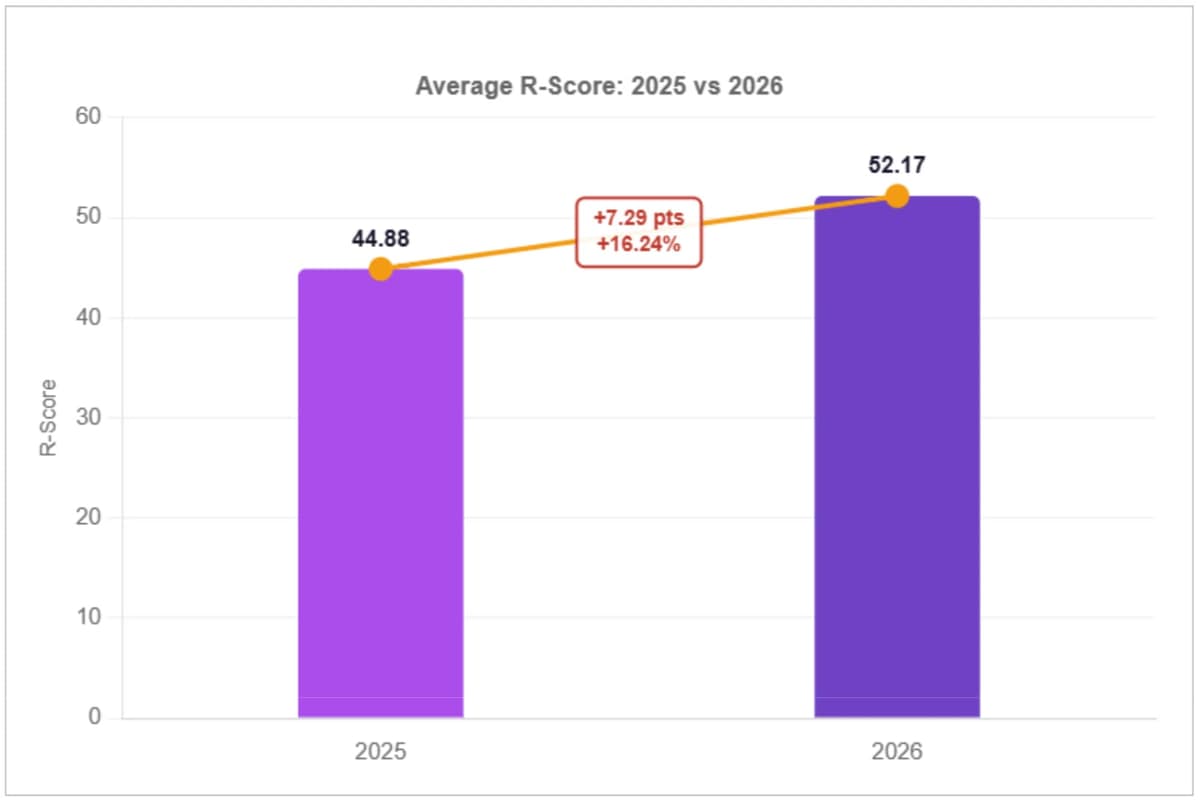
In 2025, R-Scores clustered in the high 30s. In 2026, the center moves close to 50. This is not driven by outliers. Most companies improved. The shift reflects broader investment and more consistent focus on digital reliability.
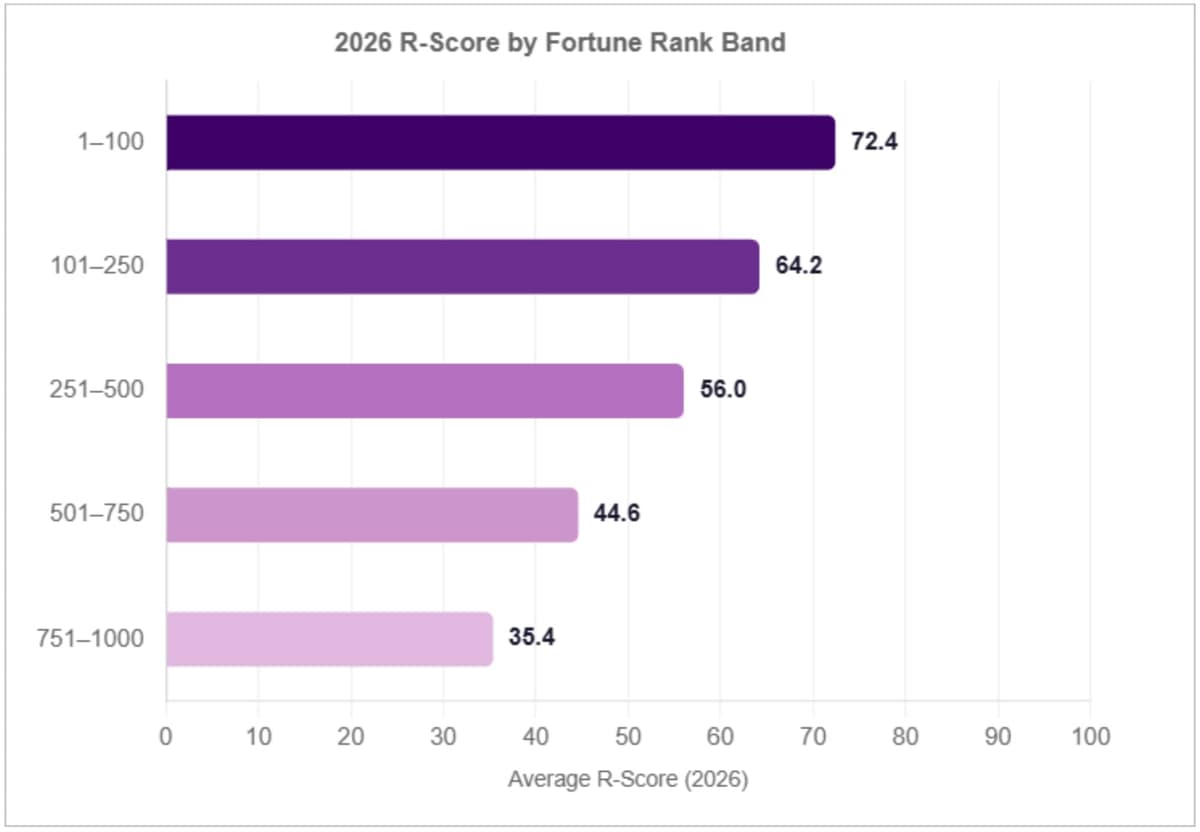
The 2025 report suggested R-Score was not strongly tied to company size. The 2026 data shows a different pattern. The Top 100 companies average 72.4, while the 751–1000 band drops to 35.4. This is a 37-point gap. It is structural.
R-Score declines consistently across rank bands. The 101–250 group averages 64.2, followed by 56.0 for 251–500 and 44.6 for 501–750. The drop is steady at each step.
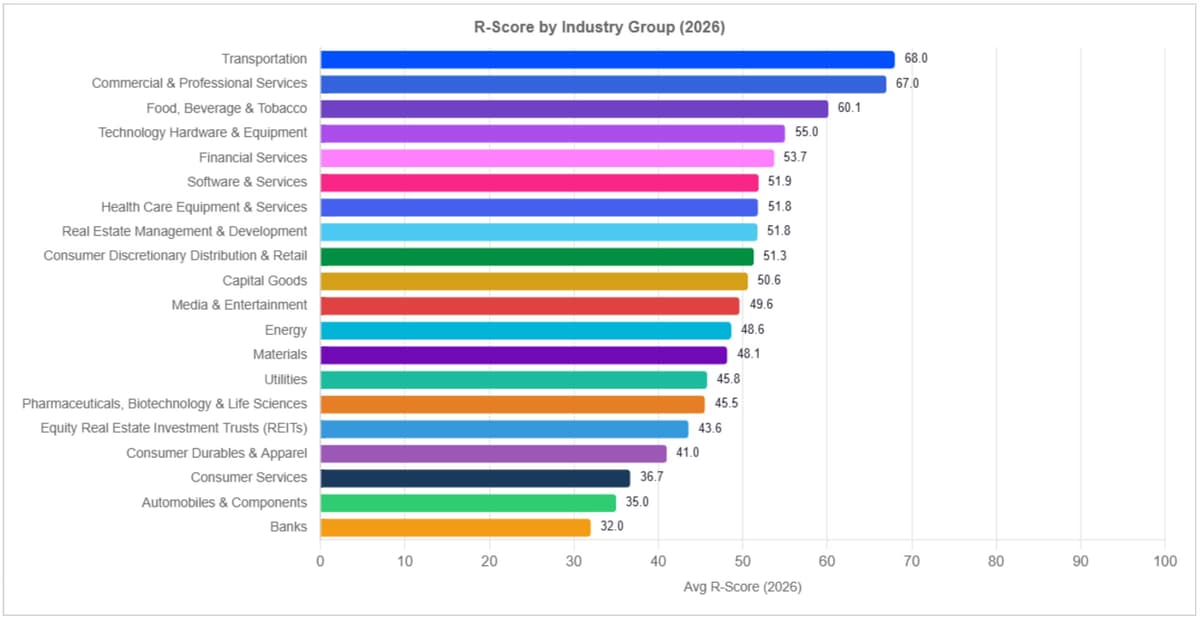
Transportation leads all 25 GICS industry groups at 68.0, followed by Commercial & Professional Services at 67.0 and Food, Beverage & Tobacco at 60.14. These sectors share high customer-facing digital surface area and mature investment in uptime and performance.
At the bottom, Banks average 32.0 and Automobiles & Components average 35.0 — both more than 30 points below the top two groups. The gap reflects structural differences in how digital reliability is treated: as a business-critical function in leading sectors, and as a compliance item in lagging ones.
| Industry | Avg R-Score | Avg Performance | Avg Accessibility | Avg Security | Avg SEO | n |
|---|---|---|---|---|---|---|
| Transportation | 68.0 | 77.0 | 32.0 | 80.0 | 71.0 | 1 |
| Commercial & Professional Services | 67.0 | 69.0 | 61.0 | 75.0 | 61.33 | 3 |
| Food, Beverage & Tobacco | 60.14 | 71.29 | 77.0 | 54.17 | 60.71 | 7 |
| Technology Hardware & Equipment | 55.0 | 50.0 | 93.0 | 45.0 | 69.0 | 1 |
| Financial Services | 53.72 | 64.12 | 71.28 | 49.02 | 60.92 | 50 |
| Software & Services | 51.88 | 57.4 | 63.85 | 57.57 | 61.69 | 16 |
| Health Care Equipment & Services | 51.8 | 66.85 | 65.61 | 41.62 | 64.5 | 20 |
| Real Estate Management & Development | 51.75 | 58.38 | 72.0 | 42.29 | 61.25 | 8 |
| Consumer Discretionary Distribution & Retail | 51.31 | 62.57 | 70.31 | 49.25 | 53.38 | 16 |
| Capital Goods | 50.61 | 60.85 | 68.64 | 48.04 | 59.28 | 439 |
| Media & Entertainment | 49.61 | 59.91 | 77.0 | 39.39 | 63.39 | 23 |
| Energy | 48.64 | 64.8 | 73.17 | 50.38 | 53.48 | 25 |
| Materials | 48.15 | 62.08 | 63.27 | 44.09 | 59.77 | 13 |
| Utilities | 45.78 | 54.33 | 76.62 | 47.8 | 60.78 | 9 |
| Pharmaceuticals, Biotechnology & Life Sciences | 45.5 | 39.0 | 83.5 | 70.0 | 55.5 | 2 |
| Equity Real Estate Investment Trusts (REITs) | 43.57 | 56.0 | 52.5 | 47.4 | 63.0 | 7 |
| Consumer Durables & Apparel | 41.0 | 65.33 | 92.0 | 40.75 | 58.2 | 5 |
| Consumer Services | 36.67 | 33.33 | 63.0 | 31.33 | 43.33 | 3 |
| Automobiles & Components | 35.0 | 59.0 | 47.5 | 12.0 | 44.5 | 2 |
| Banks | 32.0 | 0.0 | 97.0 | 23.0 | 69.0 | 1 |
* Consumer Staples Distribution & Retail includes companies such as Walmart, Costco, Kroger, CVS, Target, and Walgreens.
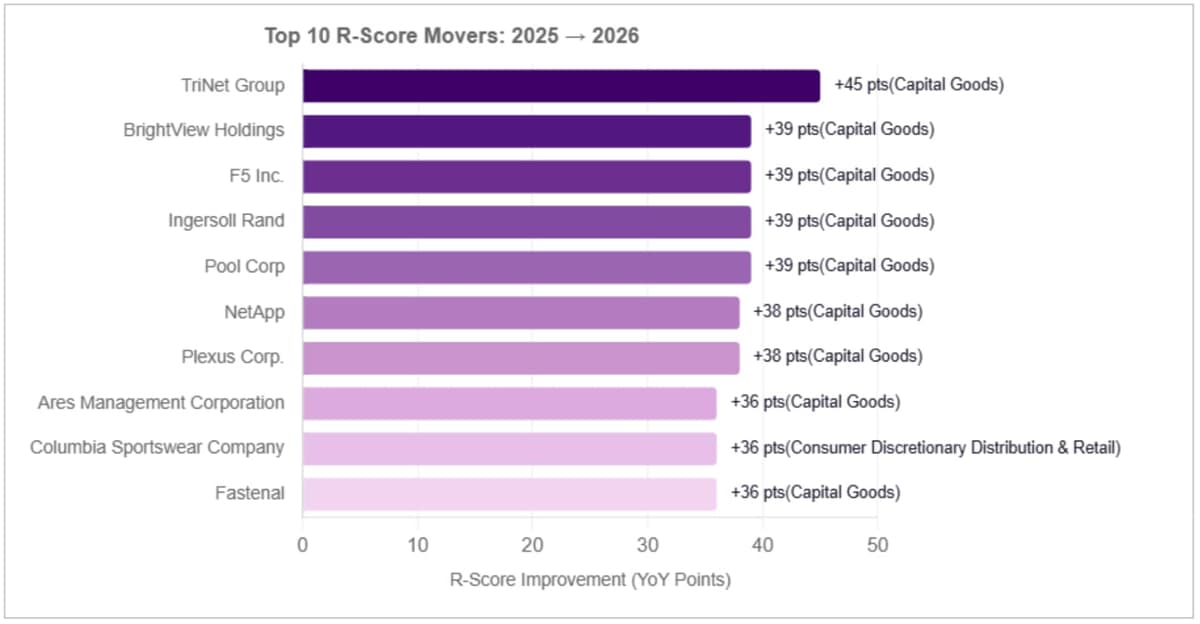
The largest year-over-year R-Score improvements show a mixed pattern across companies.
TriNet Group gained +45 points in a single year. BrightView Holdings and F5 Inc. each gained +39 points. These are not incremental improvements — they represent a complete repositioning within the R-Score distribution, moving from Lagging to Progressing or beyond in one cycle.
Gains of this magnitude do not happen through sequential fixes. They reflect coordinated investment across performance, security, and accessibility simultaneously — triggered by a strategic digital transformation initiative, an infrastructure overhaul, or new technical leadership. Companies waiting to fix one layer before the next are watching these movers demonstrate that a different approach is possible.
| Company | R-Score 2025 | R-Score 2026 | Change |
|---|---|---|---|
| TriNet Group | 16 | 61 | +45 |
| BrightView Holdings | 31 | 70 | +39 |
| F5 Inc. | 28 | 67 | +39 |
| Ingersoll Rand | 7 | 46 | +39 |
| Pool Corp | 7 | 46 | +39 |
| NetApp | 31 | 69 | +38 |
| Plexus Corp. | 36 | 74 | +38 |
| Ares Management Corporation | 26 | 62 | +36 |
| Columbia Sportswear Company | 33 | 69 | +36 |
| Fastenal | 31 | 67 | +36 |
* Year-over-year R-Score changes based on matched company records (2026 dataset).
Ensure your website is high-performing and trustworthy with Oshyn’s free AI-enabled Reliability Report. This comprehensive report delivers the same deep technical insights that Oshyn used to create its prestigious Digital Trust Index.
Start Your ScanAn overview of why Security is the bedrock of digital trust.
How sub-second load times correlate with brand reliability.
This explains the transition from "checking a box" to "inclusive UX."
A deep dive into how well a brand is found by both humans and AI agents.
Whether you’re an established brand or rising through the ranks, we’ll help you identify—and fix—the specific friction points holding your digital trust back.
.png?width=2560&quality=75&format=pjpg&auto=webp)
.png?width=2560&quality=75&format=pjpg&auto=webp)
.png?width=2560&quality=75&format=pjpg&auto=webp)